On Growing Older and Running Out of Pages… (Finding the Time to Read)

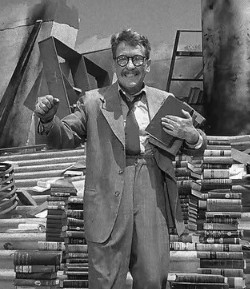
Okay, this is going to be a long one. And I’m going to put this on my Medium and my Substack. How many of you remember that episode of The Twilight Zone with Burgess Meredith. It’s a famous episode. You know the one: “Time Enough At Last.” Such an iconic story. So this essay is mostly about finding the time to read when we get older. A lot of us don’t have that luxury, so think of this as a kind of exercise. Maybe we can do this challenge together, and it can become routine.
People often ask me what writing part-time is like; I used to do it full time in the 2000s. Depending on what kind of writer you are, you’re basically putting your thoughts into words and getting them down on paper. You’re living out a fictional scene in your head and trying to put that scene into words, along with the world around it. You’re doing a lot of typing, a lot of line editing, a lot of reading. Then you return a week, maybe two weeks later, to revisit what you wrote and do some more polishing. Improve what you started, improve your craft, experiment with things like structure and style. Even when you’re not writing, you’re reading.

If it’s not gate-kept, writing is a numbers game where you’re constantly creating content, trying to make it into some bigger editor’s second or third reading tier. And you do this because you have to; you don’t really see yourself not doing it. At the same time you’re investing in your portfolio—fiction or non-fiction—and trying to get a paycheck from it if you’re lucky. It could be a short story, a novel, an article, even greeting-card jingles or nonsensical filler that, surprisingly, sells. If you’re like me, you might be banging out anywhere from 40 to 65 pieces per year.

Now a voice in the back row just said, “Hey, that’s great, Larry. You write a lot of stories, produce a lot of content. You’re in so many anthologies and magazines. You submit to so many places. But how do you read all these books? How do you find the time?”

Honestly, as you get older, you don’t. I’m looking at a giant pile of books behind me as I write this. It’s a mess here. I’m old now, and I’ll never get to all of it. I know that. And the trouble is, every time I’m in Manhattan, I keep picking up books and never getting to them. Obviously, short stories and novellas are more approachable than full-length novels these days. For me, at least.

Between 1985 and 2005, I read voraciously. Sometimes two to three paperbacks per week. Before my son was born, I had bookcases upon bookcases of pulp paperbacks, old Galaxy and Analog magazines, Hard Case-style crime thrillers in the vein of James Bond, Charles L. Grant anthologies, Stephen King novels, DAW “Best Of” collections. I had a collection of 2000 books. These were mixed in with the essential satires and mainstream dramatizations of the 1960s, 70s, and 80s—Kurt Vonnegut, Joseph Heller, Mario Puzo, Ira Levin, etc—the three most important decades of literature. But then you realize you have to change diapers, make formula, sing lullabies, rock carriages, go to playgrounds and push swings. Cook meals, send kids off to school, exhausted. And you have to co-parent until that kid turns eighteen and goes off to college.

You can’t get to all those books. Maybe at night in bed, or on a commute, or on the toilet doing business (don’t laugh), you get a lengthy chapter in. Then, when they go off to higher learning and hang out with their friends, you return to what you started. But there’s still never any time. It’s always that way. So I ended up donating the vast majority of those 2000 books, throwing a few away, giving some to libraries, and selling lots on eBay.

And what if you work demanding ten-hour days in the middle of nowhere, where you have to hop on the turnpike, beat the traffic rush, and drive home? What if you want to go out, have a drink, go dancing, go to a nice restaurant, socialize? What if you have other hobbies?

For example, one of my hobbies is console gaming. PlayStation, Nintendo, and the like. I have 700 physical video games sitting on my shelves. Yes, 700 games with replay value—or still sealed. You might have more than one hobby. Some people have a few. Like gaming, I also collect action figures and cars. I’m part of a few diecast communities these days. But you have to go to stores and hunt those things down.

A year ago, I bought an iPad with my royalty money. One of those nice ones with a lot of memory. The purpose was to read books and review PDFs wherever I went. On the go. You know, other than downloading a few Apple songs, I haven’t even really used that iPad yet. I recharge it every few months so the battery doesn’t run down and bloat.

I used to watch television. For years I was a die-hard Walking Dead and LOST fan. I watched those two shows religiously, while devoting extra time to British imports like Doctor Who and Torchwood. I got rid of the Disney Channel, got rid of TV. I don’t watch television anymore. The Walking Dead ended after 11 seasons, I gave Ncuti Gatwa (the 15th Doctor) two years of my time, and I felt that was the end of my TV days. As for movies, I go to the theaters twice per year. Superhero films don’t interest me like they used to, and IMAX doesn’t really have anything either. I’m fatigued by the fandom surrounding modern cinema. And there’s just no time; although I am looking forward to the Super Mario Galaxy movie.

Also, as you get older you get less sleep and you’re prone to afternoon naps. There’s the grocery shopping, the laundry, the quick cleaning of the kitchen countertops and bathroom. As you age, you forget stuff. Your brain shrinks. Your eyesight goes on you, and you have to read passages more than once to comprehend them. And you have to take care of your body—gym, yoga, outdoor fitness—because you’re aging and your body can break down. More time away from books.

Then there’s social media—talk about time-consuming—a rabbit hole that can steal your life away. These days I use one or two pieces of social media. I have a TikTok. I don’t even use it. I use BlueSky. And you know what? With only one or two platforms, I get more work read and more exposure publicly. When I had ten pieces of social media back in the 20-teens, I was read and noticed less. Sometimes less is more.

After everything you’ve just read comes the fact that you have to be a picky reader. There are over one billion books worldwide. Think about that number. There are over one billion authors—dead authors, living authors, traditionally published authors, small press authors, children’s authors, fiction writers, non-fiction writers, textbook writers, anthology writers, self-help writers, self-published writers. There’s new books, used books, ebooks, audiobooks, web novels. You will never get to all the books you want to read, no matter how hard you try. You have no choice but to pick and choose, and you have to do it wisely.

So I decided to sit down this winter and choose five books—just five—that I know I’ll actually get to. Books that interest me, that have been tapping me on the shoulder for a while now. The plan is to spend January, February, and March reading these particular titles. And once I’m done telling you what I picked and why, I want you to choose your five, too. We’re doing this together.

These five books are our January, February, March. They can’t be just any books. Life is short, time is precious. They have to resonate. If your schedule is packed, let that be a recurring theme. Five is an easy, honest number to work with. Then when the weather is cold outside next year at this time, you can do it again with another five books.

Number 1: “Pinball” by Jerzy Kosinski
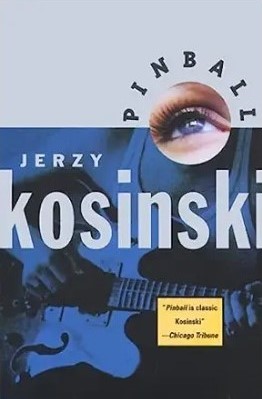
I picked this book not just because I’m familiar with Kosinski’s work, but because the premise hooked me right away. It’s an alternative rock-and-roll murder mystery, with a main protagonist sculpted after one of the Beatles. To my surprise, when Kosinski was alive and living in New York, he was actually close friends with George Harrison, and this book is dedicated to that friendship. Only here, the story turns on a female stalker with a past who shadows the protagonist everywhere he goes. So I’m definitely looking forward to this one this winter. Other Kosinski books I’ve read include The Painted Bird and The Hermit of 69th Street. Hermit was “meh”—your mileage may vary—but The Painted Bird is concentration-camp fiction at its finest, drawn from Kosinski’s real life as a Polish refugee who, as a young boy, witnessed unimaginable atrocities during World War II.

Number 2: “Welcome to the Monkey House” by Kurt Vonnegut
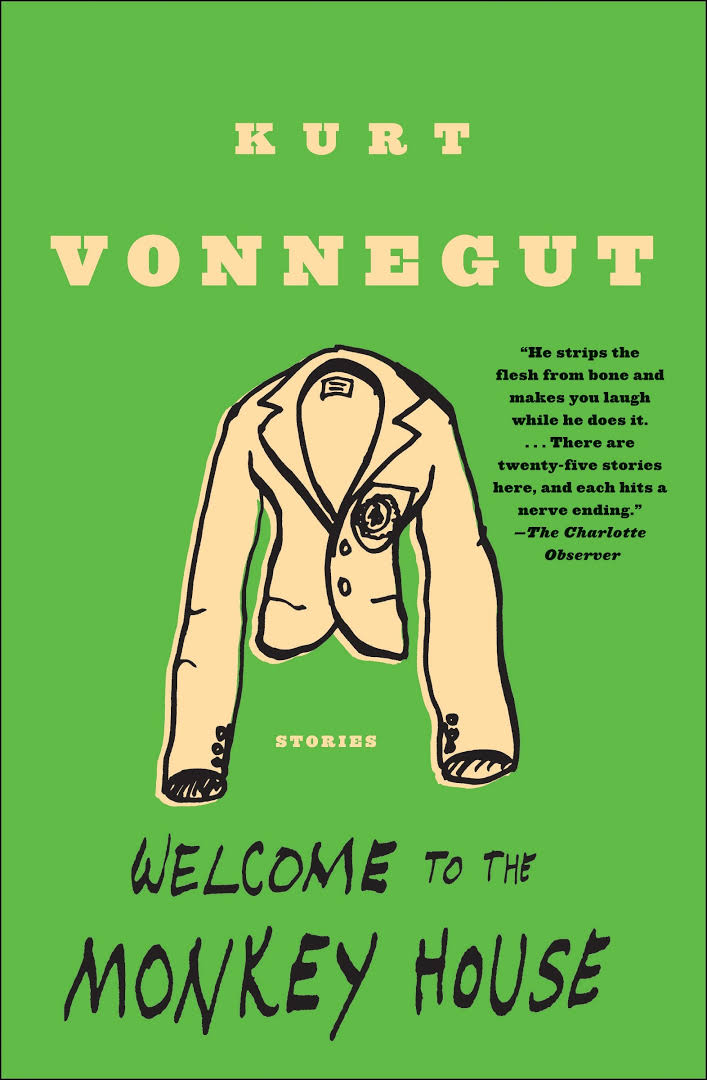
I used to know Kurt Vonnegut back in the ’90s. We lived near each other, and I’d deliver his prescriptions; he had a house account at the pharmacy where I worked. I was going to school at night then (for writing, obviously), and he’d toss me these little bits of advice, kind of like a humorous mentor who wandered in and out of my day. I remember sitting in the second row at his Timequake reading and premiere in an area of Manhattan known as Turtle Bay around ’98. He signed my copies of Slaughterhouse-Five, Breakfast of Champions, and The Sirens of Titan—three of my all-time favorites—and I tore through his paperback of essays and reviews, Wampeters, Foma, and Granfalloons. But I never really sat down with his science fiction short stories. This collection covers the pieces he wrote in the 1960s. Yes, Vonnegut started out as a speculative fiction writer; a lot of people don’t know that. And it’s one of those books I want to finally get around to reading this winter.

Number 3: “Later” by Stephen King
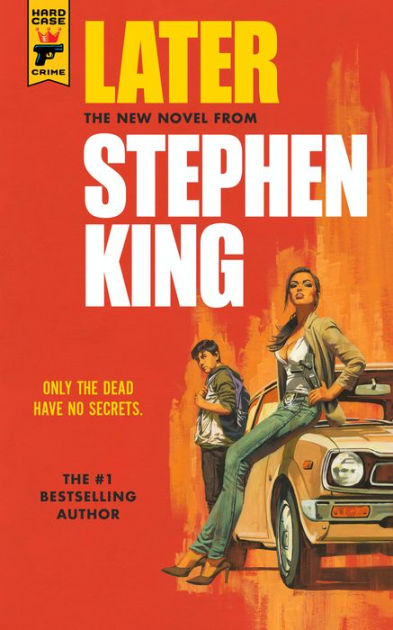
I usually devour anything and everything Stephen King. The last thing I read by him was Doctor Sleep. I know, that was a long time ago; remember what I said about co-parenting above. But this one—this book—I’ve been sitting on for well over two years now. It’s got one of those gritty Hard Case Crime covers that just punches you in the gut. I grabbed it at Strand Bookstore on the cheap. I heard they were turning it into a miniseries with Lucy Liu, though for all I know it already came out and I’m late to the party. From what I understand, it’s a supernatural coming-of-age thriller with shades of The Shining and The Sixth Sense. It’s got horror, it’s got true crime, and one of the main protagonists is a single mother struggling in New York City. My hometown. So yeah, this one is right up my alley. Now I just need to stop procrastinating and finally give it the time it deserves.

Number 4: “Comedy Writing Secrets” by Mark Shatz (with Mel Helitzer)
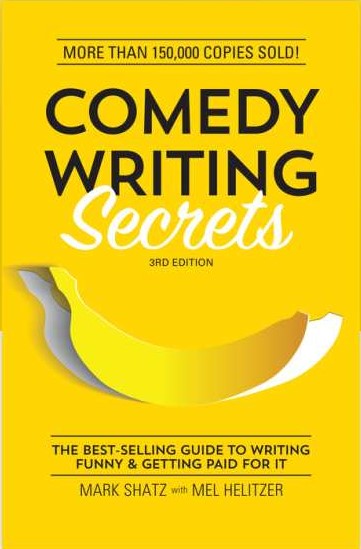
Yes, this one’s a “how-to,” an instructional book I picked up recently. Something that might tighten or sharpen a few corners of my writing. Why wouldn’t I want to improve myself? And don’t get me wrong, I know how to write humor somewhat effectively (see my short story “How Jones Goes”). I’ve been paid and published for humor before. I know how to slip it into my speculative fiction when the moment’s right; horror, not so much. But humor is a field that pays well, and I want to write comedy better. Why wouldn’t I want to write anything better? An editor recommended this book—and another, actually—so I went to Barnes & Noble in Union Square and grabbed this one. It’s sold more than 150,000 copies, so on that I’ll give it a try. I want to write more humor, more satire, in the years ahead, and if this can help me get there, then it’s worth spending part of my winter reading it.

Number 5: “Dagger of the Mind” by Bob Shaw
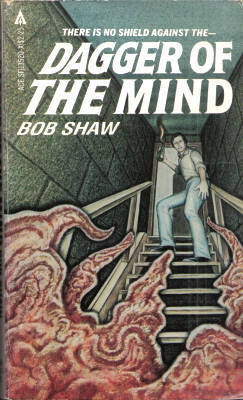
The book above is the version I have: a first-edition ACE paperback from 1979. Vintage, extremely rare. And remember what I said earlier about the 1970s being some of the best years for literature. This copy is a tough find, and I was lucky enough to snag it for only three bucks. It’s in fine condition; no complaints. Bob Shaw was an Irish writer, by way of Belfast, and from the late ’60s through the late ’70s he turned out some of the best short fiction around. He was primarily a speculative fiction guy, a real linguist on the page, and he wrote his fair share of hard SF for publishers like DAW and Berkley. In Dagger of the Mind, the protagonist suffers from Grand Mal seizures, and it forces him to question whether he’s slipping into hallucination, tapping into telepathy, or brushing up against something paranormal leaking in from another world or universe. Now this is the kind of speculative fiction I live for. You know I want to carve out some actual leisure time and sink into this one

Those were my five picks for Winter 2026, and as you can tell, they’re pretty eclectic. I don’t box myself into just science fiction or horror. Now it’s your turn. What were your five choices? Which authors or genres pulled you in? Remember, you can do this. Five is such an easy, honest goal. So stay warm, settle in with a book, or maybe five, and let’s make this a tradition we come back to next winter.

Happy New Year,

Lawrence Dagstine

Other New Entries/Newsletter Updates: You can find the same piece reprinted here (https://lawrencedagstinewrites.substack.com/), and I also invite you to join my Substack. I don’t write exclusively about writing and freelancing. I write about growing up in New York, my life, and life in general. Over time, I’ll be testing new features Substack has implemented, including live video, and in the future the platform will also host paying anthology calls for literary work.


GHOST STORIES: “Ultramarine Literary Review” – Online Literary Magazine

Today’s acceptance is non-fiction, perfect for paranormal enthusiasts. What if I told you a Polish veteran once informed me that the forests of Poland are haunted? Strange things happen when you least expect them… Ancient curses, a man who is part owl, children and soldiers gone missing during World War II, supernatural castles in the woods, and genuine gravemarker tours. For this piece, I researched the spectral. It’s a regional article on the lore of one of Poland’s most notorious and spooky forests bordering Germany. Read my article: “The Haunting of Notecka Forest.” It’s based on valid research and a veteran’s true accounts. You can read it now in the new Chilean-based online literary journal, Ultramarine Literary Review. They also publish fiction, poetry, book reviews, and video game reviews in English and Spanish. Edited by Catalina Bonati. I will provide all necessary links below.

Ultramarine Literary Review – Chilean-based online literary magazine

Featuring paranormal article: “The Haunting of Notecka Forest.”

ULTRAMARINE LITERARY REVIEW HOMEPAGE (click below):

https://www.ultramarinereview.com/

ULTRAMARINE NON-FICTION PAGE/ARTICLES (direct link below):

https://www.ultramarinereview.com/articles-1

ULTRAMARINE FICTION PAGE/SHORT STORIES & POETRY (direct link below):

https://www.ultramarinereview.com/short-fiction-and-poetry

Since this is a literary review, I’ll put the banner under magazine credits.

Other New Entries: “Magazines”

Other New Stuff in Addition: “Lawrence Dagstine Newsletter”

https://lawrencedagstinewrites.substack.com/

Lawrence Dagstine: “2024 was my most productive year…but wait, there’s MORE…

2024 will arguably go down as my best year in writing and submitting; 2023 wasn’t so bad either (The Nightmare Cycle was published and I got an advance for it). I wrote a record sixty-five short stories between November 2023 and December 2024—all new. During that time, I also received the most book, anthology, and magazine acceptances (some yet to be released) for a single calendar year, surpassing my previous record year of 2008. I received acceptances from a variety of markets—mainly genre, as that is my specialty—in science fiction, fantasy, horror, and even humor. These markets ranged from pro-identifying to token, including small press and micro press. I also appeared in two anthology-magazines that went to number one on Amazon; another Kindle Anthology broke the Top 100 in World Literature, and a handful of my other offerings made it into the Top 100 or Top 500 sales rank-wise. That’s never happened to me before. Additionally, I have a couple of new books out right now (see right-hand column, scroll down).

My rejection ratio was fifteen turn-downs for every acceptance, if you’re curious about the odds. Yes, where there are acceptances, there are rejections. It comes with the territory. But I’m not here to toot my horn. This was a personal goal I wanted to achieve, and I did. I wanted to see if I still possessed that 2000s-era magic.

At fifty years old, you stop measuring press levels—Pro, Semi-Pro, Hobby, Indie—and accept whatever comes your way, especially if it’s available physically (paperback or hardback), and you know how to hustle and sell it. Believe it or not, most of my readers are not from the United States. Many Americans are too dependent on technology, staring at their smartphones all day, or engaging in activities that don’t involve literature. If they do read, it’s usually the “obligatory” twelve books per year—one per month. I’m guilty of this myself. I used to read a hundred books per year, but as you get older, there are only so many hours in a day. Most of my readers hail from places like India, Japan, and, oddly enough, Belgium. Earlier this year, readers from India wrote to tell me how much they liked my horror stories. I appreciate that; I’ve never received such feedback from US readers. Obviously, I was flattered. I joined two writing groups in Manhattan, got the necessary certifications, and became a writing teacher, which is relatively easy in New York State compared to other places.

As we get older, we often become adjunct professors, tutors, instructors, substitute or assistant teachers. We take up residencies, shepherd online MFA programs, hold online and in-person workshops, and add experience to our curriculum vitae. The revenue from these workshops helps fill our fridges. We may teach English as a second language if we move overseas or teach the short story form, novel writing, story analysis, and linguistics. We show younger writers our techniques and formulas, paving the way for them and enlightening them on how we did it. We pass our knowledge to the next generation of aspiring writers. We take on protégés. Other jobs we take on include writing advertising copy, technical writing/business writing, expository essay writing, things like that.

I can’t believe I’ve been doing this for thirty years. Sometimes I wonder if I wasted my life. Should I have pursued another field? Should I have become a full-time artist and taken up comic illustration, which was my passion in the early ‘90s? Despite my love for science fiction, I would have preferred seeing the art through. I lost my love for drawing in late 1994 and turned to writing instead. Applying for art jobs thirty years ago, where prospective employers said comic art and graffiti art weren’t “real art” didn’t help. So I ended up in writing. I appeared in a couple of magazines, made some cash, and bought nice things. Picking up every genre magazine I could get a hold of in Borders and meeting Kurt Vonnegut regularly while working as a delivery boy for a pharmacy further fueled my enthusiasm.

Author Mercedes Lackey once noted that 90% of the writers in the SFWA (Science Fiction Writers Association) have had or currently hold full-time jobs. The rest have spouses who work full-time, serving as the breadwinners, covering the overhead, and providing health insurance for the family. Alternatively, the full-time writer might be retired and living on a pension or 401K. I could join the SFWA tomorrow. But at my age? For what? Bragging rights? I’m ready for the grave. This isn’t to say I won’t produce an anthology in the future. I’m full of ideas, and I won’t accept anything less than outstanding. But hey, I’m old. Many of the books with my stories are published by presses that might not exist in five or ten years. Presses come and go; the same can be said about good books. Publications go on lengthy hiatuses. Economies rise and fall. Inflation affects spending habits. People’s reading preferences change. Advertising techniques and technology evolve. Not only that, over 10,000 books are self-published per day, so there’s no such thing as professional competition anymore. It’s a too-open field. Also, generational shifts happen, and what was popular with one generation might not be with the next. How many people do you know in 2025 who have a profound love for Philip K. Dick, Isaac Asimov, and John Brunner like I do?

I’m very much a socialite. I often go into the city, visit upscale places, penthouses, private parties, and get the VIP treatment. I network and get my books into these places. You have to network in this day and age. Word of mouth is still a very powerful tool, and you want to get non-genre readers interested in reading genre. When I sit down with a glass of wine and talk to affluent or corporate types about horror, they say, “Oh, Stephen King!” And that’s it. They don’t know anybody else. They think Stephen King is the only author there is when it comes to horror. I say, “You haven’t read the work of Paul Tremblay, Stephen Graham Jones, or Josh Malerman?” They give me a daft look. Who? What? They don’t even know that Stephen King has two sons who also write (Owen and Joe). They think Stephen King never had children. But we know. Because writers read each other. We are aware of each other. And it’s kind of depressing in a way. It’s like we’re trapped inside this shrinking genre bubble, and you’re not sure if it’s going to burst or when it’s going to burst. It’s disintegrating, for sure, it’s just a matter of when. You hope it pays your utilities for as long as it can, at least until you take up a teaching position or land an agent. Only 15% of writers ever land an agent and break into the Big Five. And that number shrinks with age. Some are luckier than others; your mileage may vary. What happens for most, whether traditionally published or indie-published, is we end up at genre conventions, gaming cons, comic cons, indie bookstores, or local fairs and fests, and our literature is available at vendor tables.

Nowadays, many people publish each other in a quid pro quo fashion (tit-for-tat), which is fine, but simply reading each other’s work isn’t sustainable in the long term. It seems we’re just passing time until we reach the end. If we’ve chosen writing as our forte, we must have a lot of time to spare. Some of the biggest names, award-nominated genre writers, are suddenly submitting to semi-pro and token markets. This used to be a no-no. Yesterday’s professional paying magazines now depend on Patreons or annual crowdfunding just to survive. And then there’s Artificial Intelligence, which will inevitably replace us in the next 20 years. I’ve seen some of these young tech kids at conferences, and what they can do with Python and Stable Diffusion; they’re smart.

Publishing was a very different animal in the first ten years of the Internet. You could actually make an income from freelancing regularly, and web content was big! Webzines were especially big. They were new, they paid fair money, and there wasn’t much of an editorial filter, but you got your byline and content out to the world. A handful of these sites were built with Dreamweaver, Frontpage (Microsoft), or typical HTML coding. Some were even hosted by GeoCities. Plus, the cost of living was cheaper back then (my rent was only $650 to $750 per month during this era, utilities included). You could stay home, take care of the kids, and have paper checks coming to your mailbox. This was still before the age of PayPal, Venmo, Zelle, and other electronic payment methods. So it was paper checks. If you were a freelancer of genre fiction and creative non-fiction, and you were a quick writer and productive, you got paid $20 to $50 per piece consistently! Sometimes more, sometimes less. One on top of the other. Some of the webzines that appeared in the first ten years of the Internet were Atomjack Magazine, Whispering Spirits, Midnight Times, Dawnsky, The Random Eye, Gotta Write Network Litmag, and hundreds of others! I appeared in many of these places, scouring market sites like Ralan and Spicy Green Iguana on a daily basis. The Boomers never went near these little zines, but I did. And I got my name out there. And I was paid. And I bought clothes. And I bought food. And I paid bills. At one point, I even had a $6000 bank account put aside for my infant son—from writing. There was a time when I had 200 different stories in a folder on a Windows XP laptop, and I would submit to any paying market, even those offering $5.00 compensation. Acceptance here, acceptance there. You do the math. You might find these webzines on the Wayback Machine, but if you’ve heard of the ones I just mentioned, you’re old and gray now, just like me.

To this day, I think the periodical I was paid the most for a single story or article was in either 1999 or 2000, and this was in a queer publication called GENRE Magazine. Or just Genre. And it had nothing to do with genre. They didn’t even publish science fiction. That was just the name. It was primarily a New York-based gay lifestyle magazine with a modest circulation for its time period. It was distributed to LGBTQ-identifying establishments before LGBTQ was even a term. Before ebooks, before Amazon, when physical publications still had modest circulations. When people still relied on the Writer’s Market. I was paid $750 for two, maybe three hours worth of work. The editor said he would take care of the grammatical errors. I kept my mouth shut, let him handle it. Nowadays, twenty-five years later, that same $750 is your paycheck for a horror novel to a rising indie press.

Still, I’m thankful I didn’t become a full-timer in this day and age. I own nice things. Call me materialistic, but I enjoy my little luxuries: designer clothes, nice electronics, video games. I can buy my family birthday and Christmas presents. I can wine and dine on occasion. Some writers who went all-in don’t have that luxury. Imagine not having health insurance, unable to run to an emergency room or urgent care. A vast majority of writers don’t have insurance. Sure, some scored two or three-book deals with the big houses, only to not sell to expectations and never be heard from again. So when people ask me what advice I would give an aspiring writer in 2025, I say, “Don’t quit your day job. Do this strictly for passive income. Do this because you love it. For the sake of art. Do this because you like to tell stories. And read!”

Listen, H.P. Lovecraft died extremely poor. He couldn’t afford treatment for his small intestine cancer, compounded by his fear of doctors. So, he wrote and lived in daily pain—not a pot to piss in. Some of his finest works weren’t noticed until decades later. John Wyndham, a prominent British science fiction writer, was often overlooked in his lifetime. He didn’t receive the recognition he deserved, even as the author of “The Day of the Triffids.” It’s only now, in the 21st century, that his shorter works are being sought out and reprinted. John Brunner, author of mega-hits like “Stand on Zanzibar” and “The Crucible of Time,” feared failure. He wrote under a pen name in his later years and worked as an underpaid proofreader. But regardless of success, they were storytellers. And there’s nothing wrong with being a storyteller. If you get paid for it, that’s like the cherry on top of a hot fudge sundae.

Looking back, I’d say I’m privileged. I’m not a New York Times or USA Today Bestseller by any means. I see myself as a semi-pro of the short form, one of those one-to-three cent jobbers. Apparently, I’m a jobber who makes it into the TOP 100 often; I probably would’ve really crushed it during John W. Campbell’s era. Many writers don’t get to do this for three decades, non-stop. Today, many people self-publish books that are mediocre at best, invest in Amazon Ads, and suddenly they call themselves bestselling authors. They don’t know what it’s like to have spent time in the trenches. Otherwise, a handful of the younger kids coming up don’t know how to read, write, spell their names, or pick up a book after high school. I definitely didn’t think I’d become a teacher. Like I said, I feel privileged. I came to this earth and got to do it. And I’ll try to continue doing it for as long as I have the desire.

This is Lawrence Dagstine, prolific writer for the past thirty years.

Storyteller. Jobber. Future anthologist? I could live with that.

Edited to Add: This essay, which I write from firsthand experience, will be reprinted in a newsletter, currently under development. Stay tuned for news of that.

Proofreading and Writing Services – Satisfaction Guaranteed!

Hi, my name is Lawrence, and I’m a writer of fiction and non-fiction.  If you clicked on this page, then you are probably interested in my proofreading services, or at the very least, wondering what I can do in regards to the written word.  Let me first tell you a little bit about myself and this website.  Many people know me as an author of speculative fiction (science fiction, fantasy and horror), and my name is pretty synonymous within the small press.  I’ve been writing for well over fifteen years, and I have an extensive publishing history.  Think of this site as a sort of virtual resume of some of my previous work, upcoming work, and publications.  Not just the services I provide, since I consider myself a working writer.  I’ve been called prolific when it comes to writing short stories and informative when it comes to magazine articles.  Wherever I go, any social media platform I visit, people tend to say, “Oh, Lawrence Dagstine, he’s that Scifi/Horror writer.  Sure, I’ve heard of him.”

This is me, hard at work for you.

Unfortunately, it’s a label I’m stuck with—because I chose to enter that field and write in that form.  You see, as a child I grew up to movies like Star Wars and Aliens, TV shows like Doctor Who and The Incredible Hulk, and I read Marvel comic books and digested good science fiction literature (no, great!).  Isaac Asimov, Arthur C. Clarke, Robert Heinlein, George Orwell, Ray Bradbury, you name it.  I read voraciously! I lived around the corner from a Forbidden Planet and was practically there every day.  I did book reports on lengthy Stephen King novels in 2nd and 3rd grade, and was the head of the boys in reading and writing in my school district at the time (the 1980s).  Years back my IQ was tested and I got a score of 150 (teachers called me gifted).  I even delivered prescriptions to the late Kurt Vonnegut and, for a brief period, became friends with him and he a sort of mentor to me.  So reading and writing, especially genre, has always been in my blood.  But I prefer to be called a Freelance Writer because I work with words in general.  It’s what I studied.  Not just fiction.  Genre fiction is pretty much the “fandom” side.  And it is very hard to make a full-time income writing fiction, as most genre writers are paid a pittance.  I’ve known writers who got their BA or MA, thinking they were going to write the next literary masterpiece or appear in The Paris Review, only to become editors or teachers.  They weren’t delusional, they had the confidence, their hearts were in it, they just dreamed a little too high is all.  Even I dreamed high once, then my first client base involved writing and proofing pamphlets and instruction manuals.  So you really need to expand your writing skills to other areas, other venues.

Now if you’ve written something that you feel needs improvement, but don’t know how to go about fixing it, ask yourself a few questions… Have you ever had trouble with words like ‘further’ and ‘farther?’ Perhaps verb usage? Do you know the difference between their/there/they’re? Did you know that words like ‘never mind’, or ‘any more’, or ‘all together’ are not compound words? They’re all two words! Does your story have a beginning, a middle, and an end? Plenty of conflict? Because something has to happen in your story, and something has to be resolved.  The first sentence means more than you know, because it’s the first thing the reader sees after the title and byline.  It’s what immediately draws the reader in.  What about non-fiction, or product placement, or a cool advertisement? Maybe you have an idea and want somebody to word that idea a certain way, where it can potentially become a moneymaking vehicle.  Maybe you need help creating or formatting a resume or cover letter, want to stand out from the rest of the crowd when it comes time to apply for that killer job.  Need a catalog done, or a brochure, or a catchy slogan? Need some minor ghostwriting (query)? Textbook writing or editing? Essays or proposals? Striking web content for a business or organization? Help with a novelette or novella? What’s that? Want me to write you a Western Romance? Okay, I’ll write you a Western Romance.  You’re the boss.

No matter what it is, if it involves words, I can probably help you.  My publishing history consists of over 400 fiction credits in print magazines, webzines, anthologies, and miscellaneous periodicals.  My non-fiction consists of 150 credits, online and offline, for small and medium circulation newspapers, trade journals, regionals, and everyday magazines in need of good filler.  I’ve penned video game reviews in the past for Nintendo Power and written greeting card jingles for Hallmark’s competitors.  I’ve written articles on the paranormal, pharmaceuticals, beach erosion, Native American spirituality, theology, historical subjects, marriage, divorce, pets, vacation spots, real estate, wrestling and more.  I’ve shared tables of contents with two Hugo Award winners and two Bram Stoker winners.  I can do just about 75% of what’s out there.

Still in doubt? Well, ask yourself these 12 sample questions.

Do you know how to assemble a story arc? Do you know what character development is? Do you know what a three-act and five-act narrative is? Are you familiar with the Chicago Manual of Style? Have you ever referenced the work of John Gardner (On Becoming a Novelist, The Forms of Fiction, The Art of Fiction)? Do you know the difference between literary and mainstream? Do you know what structural analysis is? Have you ever studied English Literature—authors like Graham Greene, Truman Capote, EM Forster, D.H. Lawrence, Joseph Conrad, Scott Fitzgerald, Hemingway, and the like? Do you know what proper manuscript format is? Do you know the difference between filler and feature article? Do you know how to write a pitch? Do you know the difference between a plot formula and a plot device? Heck, do you even know what I’m talking about?

If you answered no to five or more of the above, then it wouldn’t hurt to have me or some other qualified individual as your proofreader/editor.  Because I will only improve your fiction or non-fiction project, and only to your liking.  That is what I do.  I work with words.  Think of me as a sort of literary engineer.  I check for errors, make corrections, do any necessary research, and make your prose more persuasive.  I assist you in getting it the attention it deserves.  I develop fresh, innovative, and compelling work.  I drive constant voice, grammar, format, and diction across all text.  I know that your project is your baby.  It was birthed from your imagination.  But you must be able to take criticism and suggestions.  It will only help your project stand out from the rest, and help you get better.  What I am not is a copy editor.  A copy editor is an entirely different animal.  Copy editors usually work, or have worked, for publishing houses.  And good ones (not the kind you see for these run-of-the-mill small presses, who also publish their own books with the same company).  They do what’s called line edits.  They review your manuscript and send it to you with revisions in a program like Microsoft Word.  I do NOT do line edits.  Yes, I am certified in editing, but there is a great difference between a workshop certificate and a staff editor with more than 10 years experience at one of the big houses.  Yes, I have a background and education in journalism, creative writing, technical writing, and the business side of writing that could very well meet your needs.  Yes, as a proofreader I will go over your manuscript a minimum of three times, acquiring your voice and style.  Yes, I will print out your story or article, take a red pen to it, highlight certain areas I feel should be highlighted, and tell you what I think.  Yes, as your proofreader I will pay attention to the usual stuff like grammar, punctuation, spelling, consistency and sentence structure.  But I am not a copy editor.  I’m being honest here.  Even I use an outside editor for lengthy projects.  Because everybody needs a qualified editorial eye.  After all, how can you successfully edit a work that came from your own subconscious mind?

Difference between copyediting and proofreading:

http://www.dailywritingtips.com/the-difference-between-copyediting-and-proofreading/

Difference between copyediting and line editing:

http://publicizeyourbook.blogspot.com/2007/04/difference-between-copy-and-line.html

A copy editor will usually charge you by the word or line (I charge a flat fee).  They often do book manuscripts, and make up what’s called a style sheet.  If you’re looking for one, personally, I suggest looking for someone with at least three years experience.  Also, be careful of line editors posing as copy editors, as they can really screw up the flow of your manuscript if they don’t know what they’re doing.  This has happened to me.

Once again, I charge a very affordable flat fee.  Satisfaction guaranteed.  On a budget? I understand we’re still in a recession, the economy may very well not be good for years to come, and because of that, I am willing to work with you.  I expect at least half the cost of the project at the beginning of our agreement.  You are to pay me the other half after the project is finished.  Our email acts as a sort of electronic contract, if you will.  Research or additional time spent on projects (like staying up all night and losing sleep to meet a deadline on your behalf), costs extra.  And no, not an arm and a leg.  You are responsible for the cost of things like encyclopedias, visual aids, books purchased on Amazon, transportation places, or other reference materials.  I fact-check well, and I give citations where instructed or needed.  I do great copy—print copy! I’m not the kind of lazy individual who just looks something up on Google or Wikipedia.  Google is one of the worst reference tools you can turn to.  That’s because you usually find more than one answer to a particular question.  A long time ago I was commissioned to do a short article on Planned Parenthood in the new millennium.  I needed abortion statistics.  I found eleven well-rounded, informative sites by using Google.  The only problem is I found eleven different statistics.  So which was the right answer? For your project, if I have to go to a library, then so be it.  To the library it is.

I put in the time and effort to make your project as professional as possible.  I am proficient in Microsoft Word and Open Office (sorry, no crappy programs like WordPerfect).  I can give your project the treatment it deserves, and if you feel it needs work or you are not fully satisfied, I will tailor it to suit your needs at no additional cost.  I want you to be happy with my work.  I want you to succeed.  You retain all rights.  My name does not go on your written material.  I merely spruce it up.  So do you have something that involves the written word? Send me an email today for a free evaluation or price quote.  Give me an outline of your project and what you’re looking for.  Tell me about yourself and the work you do in three to six paragraphs; small businesses and companies most welcome.  If you want, I’ll even give you a freebie.  Three double-spaced pages for fiction (or 1,000 words); a half-a-page for non-fiction (150 words)—absolutely free! Have a fax machine? Want more proof emailed to you? Press clips always available upon request.  And I do simple typing too!

So contact me today, tell a friend, because no project is too large.  All material should be sent as an attachment.  I look forward to our partnership and any questions you may have.  Contact: ldagstine @ hotmail.com

Sincerely Yours,

Lawrence Dagstine

Speculative Fiction Author/Freelance Writer & Editor

Proofreading and Writing Services

Also be sure to follow me on Facebook, Twitter, and Linkedin

Other New Entries: “Proofreading Services”

Lawrence Dagstine: why I write short stories…

Many an aspiring author — and professional, too — has asked me over the past year why I write short stories.  Or, at the very least, why I choose to.  Naturally, it’s a field you won’t get rich from.  Matter of fact, if you happen to be one in that ten-thousand median author range to be on the lookout for, chances are you probably won’t even break the $5000 mark per year from all sources “writing-related”.   If you write novel-length genre works, major houses will usually yield print runs of 3000 copies.  Everybody wants a piece of the pie; the only thing is, there is no pie.  There are so many micro-presses these days that anybody can become a writer.  In most cases, this has screwed up the marketplace; I blame this slow literary death on technological globalization.

So what do we do to assure ourselves a cut and immortality? We annex and fan-club the profession.  This isn’t a terrible thing, but it’s all we’ve got right now until we come up with a better game plan, right? At the same time, I also believe we shouldn’t write for the masses because you never know what might work or what might not. 

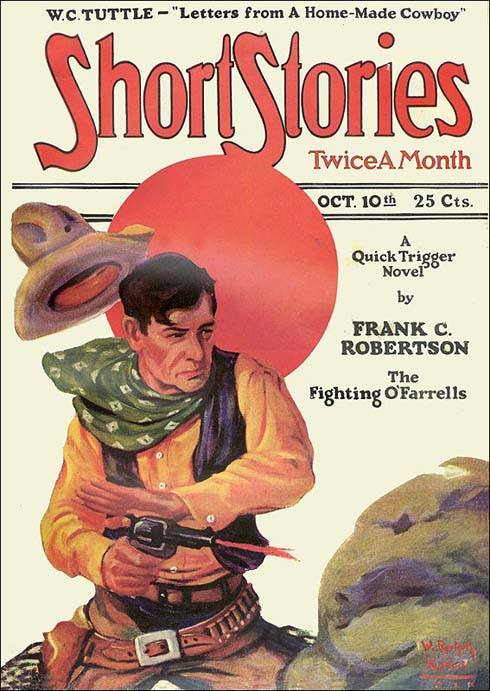
October 1927 Copy of Short Stories Magazine

October 1927 Copy of Short Stories Magazine

The writing game is the extra income game, but it’s also the poor man’s game.  Which brings me back to my original topic: why short stories? Hey, why not? Life is short, and you should get your voice heard no matter what the venue.  That’s my philosophy.  But rather than tell you what motivates me to write short stories, why I prefer it over the long form (not to say there isn’t anything in the works; that’s for another day), and why I still persist at it… Well, I decided to search the Internet for like-minded individuals.  People who prefer to write short stories, too.

The first is Bev Vincent (author of The Road to the Dark Tower).  Every once in a while I do find a little gem of a post over at Storyteller’s Unplugged.  Bev is always astute and charming in his posts, and with this particular blog entry, he practically took the words right out of my mouth.  Because these are my very same thoughts.  Along with that, I’ve provided a few other links on why it really doesn’t matter, why sometimes it does, and on how what I mentioned above is so true… Life being short, so just submit…

WHY WRITE SHORT STORIES by Bev Vincent (Storyteller’s Unplugged):

http://www.storytellersunplugged.com/why-write-short-stories

 HOW MUCH DOES WRITING PAY by Nut (The Writer’s Coin):

http://www.thewriterscoin.com/2008/09/04/how-much-does-writing-pay/

 MY WIFE IS RUINING MY DREAMS by Chris Cope (Life Files):

http://www.theindychannel.com/family/16557240/detail.html

Also, the last time I did a post of this nature I forgot to stress the importance of an editorial filter, and I didn’t focus enough on non-fiction writing.  My last rant was geared more toward genre, and I apologize for that.  However, in the same fashion, I’d rather you read “How” and “Why” I do it (and what’s to be had from it), from the likes of others, rather than myself.  And in their own words.

HOW TO WRITE FOR MAGAZINES by Jason Arnopp (Bloggery Pokery)

http://jasonarnopp.blogspot.com/2008/03/how-to-write-for-magazine.html

SMALL PRESS MAGAZINES: SHOULD YOU BOTHER? by Bruce Boston

(Sam’s Dot Publishing/Writing World.Com)

http://www.writing-world.com/fiction/boston.shtml

THE AMATEUR vs. PROFESSIONAL MYTHOS

FREELANCE PROFESSIONAL WRITERS HATE AMATEUR WRITERS by Lance Winslow

http://ezinearticles.com/?Free-Lance-Professional-Writers-Hate-Amateur-Writers&id=227821

HOW WRITERS CAN BENEFIT FROM THE SHORT STORY MARKET by Paul Turner 

http://www.articlesbase.com/writing-articles/how-writers-can-benefit-from-the-short-story-market-469055.html

WHAT MAKES A WRITER A PROFESSIONAL by Bruce Byfield

http://brucebyfield.wordpress.com/2007/06/08/what-makes-a-writer-a-professional/

INTERNET SMACKDOWN: THE AMATEUR VS. THE PROFESSIONAL by Tony Long

http://www.wired.com/culture/lifestyle/commentary/theluddite/2007/06/luddite_0621

So what are you waiting for? Go ahead and submit that story.  As the professionals mentioned in the links above, these are the same exact reasons “Why” and “How” I do it.  And always remember, just because you’re not getting a piece of the pie, doesn’t mean you can’t have your cake and eat it, too. 😉

Cheers.

Lawrence R. Dagstine

Lawrence Dagstine: The Coney Island Project…

As a freelancer, a few weeks ago I politely asked my supervising editor if I could have a crack at what is currently nicknamed: THE CONEY ISLAND PROJECT (the name is just a working title among staff at the moment, and it will be given a new name once the project is completed).  Thankfully, I have until February.  The end result will be a rich, historical look at one of Brooklyn’s most renowned seasonal attractions.  TCIP will be a 5,000 word article, which may even top 7,500 words, accompanied by full color photography and interviews with amusement park workers and area residents.  This is my first reporting gig, too, and so far I’ve taken a total of 192 pictures — 20 of which can be found below; these particular ones will probably not make the final cut.  And now that beautiful Coney Island’s final season is upon us, many of the rides are going to be knocked down to make way for a multi-billion dollar redevelopmet project — condominiums, a new redesigned theme park, a super mall, et la.  Supposedly, a rich tycoon from Iraq purchased a few rides, while tons of others were auctioned off on the Web.  Rides such as DANTE’S INFERNO, SPOOKARAMA, and BREAK DANCE, I got fantastic last day shots of (I was there for the closing).

Here’s what’s going on: http://news.yahoo.com/s/ap/coney_island

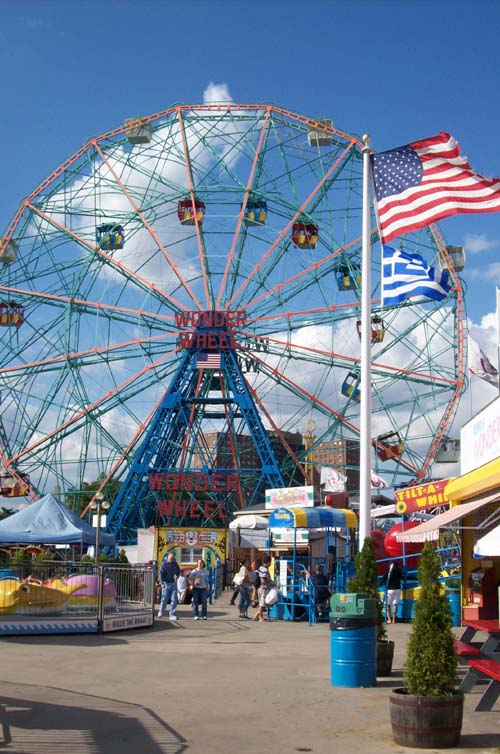
The estimated buyout was supposedly $30 Million. Astroland’s owner didn’t renew on a two-year lease.  However, Deno’s Wonder Wheel is independently owned and will be back next year.

The Wonder Wheel - founded 1920

The Wonder Wheel - founded 1920

I’m also now looking beyond the landmarks presented before you (the ones they can’t knock down), to make room for a non-fiction book filled with equally rich photography and history about the location.  The last forty or so years in particular…

Here are some more snapshots, accompanied by what they are:

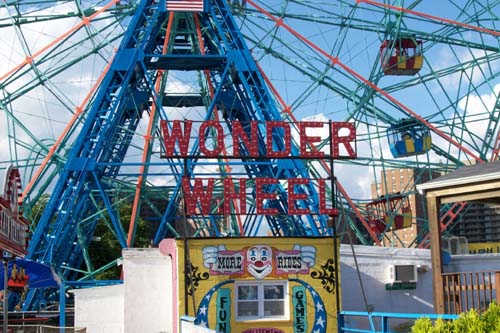
The Wonder Wheel - founded 1920

The Wonder Wheel - founded 1920

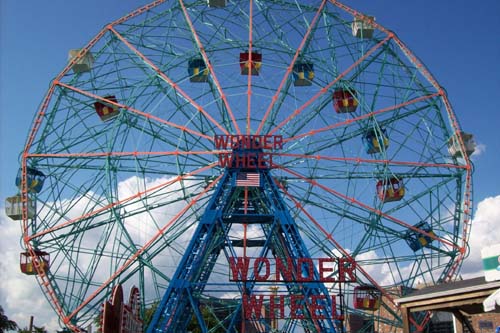
The Wonder Wheel - founded 1920

The Wonder Wheel - founded 1920

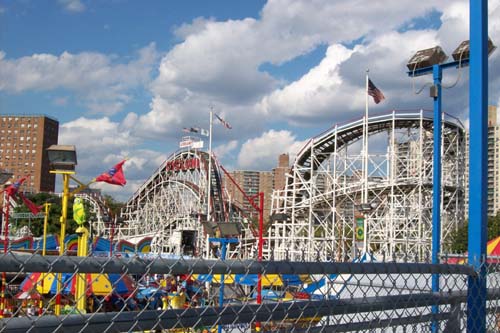
The World Famous Cyclone (side view) - founded 1927

The World Famous Cyclone (side view) - founded 1927

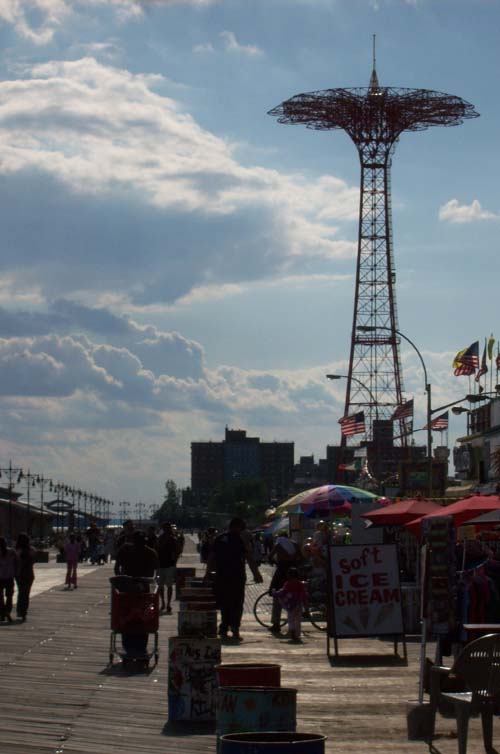
This was one of my crappier shots taken while trying to get all side angles of The Cyclone, which was founded on June 26th 1927.  Since its stunning debut more than 80 years ago, the popular roller coaster has undergone some major facelifts and renovations.  The original even burned down to the ground.  Below, you’ll find a distant shot of the infamous Parachute Jump (also sometimes referred to by Brooklynites as the Parachute Drop).  People have gotten trapped at the top of this ride over the years — sometimes for HOURS at a time — including my old man during the 1960’s.  It’s also said that, back during that same era, somebody actually got decapitated whilst coming down on it.  It was first introduced during the 1939 World’s Fair, and received much popularity from the 1950’s on.  The Parachute Jump has also undergone many renovations.  Like the Wonder Wheel and the Cyclone it, too, is a New York landmark. 

The Parachute Jump - introduced 1939

The Parachute Jump - introduced 1939

The Boardwalk

The Boardwalk

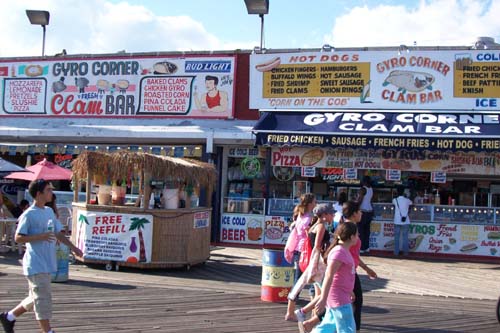
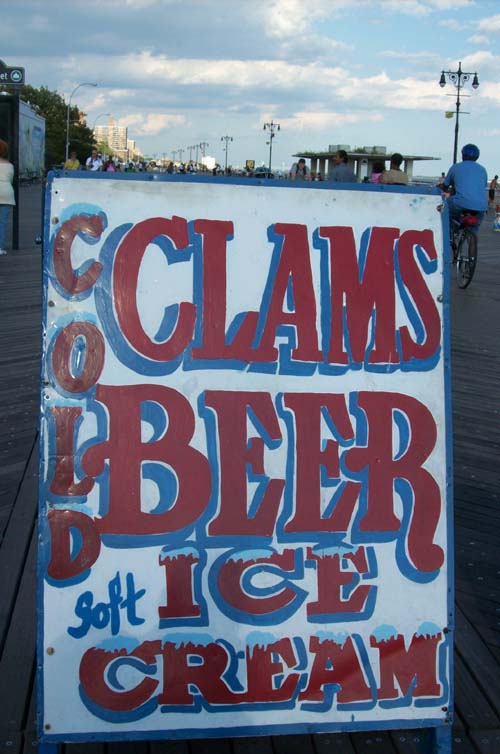
Food and Beverages Galore - only at Coney Island

Food and Beverages Galore - only at Coney Island

Up above, along with the beach and Parachute Drop in the distant horizon, the famous Boardwalk! The food here is out of this world.  During the summers, on Friday nights between 9PM and 10PM, there’s free fireworks from the beachfront.  The food vendors and shops consist of all flavors of ice cream.  Then there’s clams, shrimp, and all other manners of seafood…salt water taffy and cotton candy, fresh draft beer, pina coladas, sausage and pepper heros, gyros, pizza, hamburgers and fish sandwiches, and how can anybody forget Famous Nathan’s Hot Dogs and delicious Cheese Fries?

In the far distance, what used to be the game areas between Steeplechase Park and Luna Park have long since been closed.  Back in the 60’s, much of it was shut down due to gang violence. 

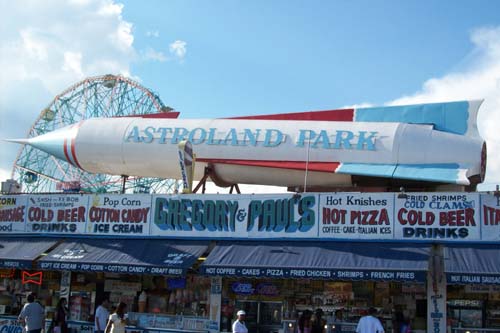
Astroland Park - leased out June 18th 1975

Astroland Park - leased out June 18th 1975

Astroland Park - leased out June 15th 1975

Astroland Park - leased out June 15th 1975

The whole area surrounding the famous rides, however, would be leased out as one big amusement park-like attraction in the summer of 1975 (a key year to my next book project), and it would come to be known as Astroland!

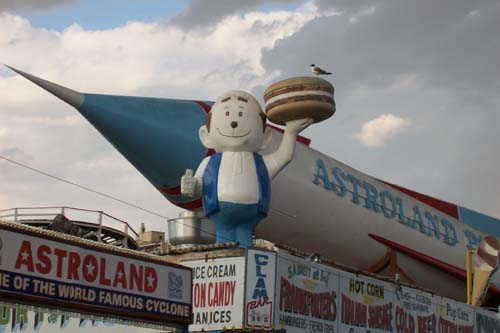
In the pictures above, one of many eateries along that particular stretch of Boardwalk.  The Wonder Wheel and Cyclone are just behind the Astroland Rocket, and I think I got a pretty good shot of the Hamburger Boy (with hungry seagull sitting atop).

During the summer, you have free concerts every Thursday night over at Asser Levy Park, which is located just along Surf Avenue and West 5th Street.  Many superstars have performed there over the years.  Billy Joel, Billy Ocean, Liza Minnelli, Huey Lewis and the News, and even Scissor Sisters!

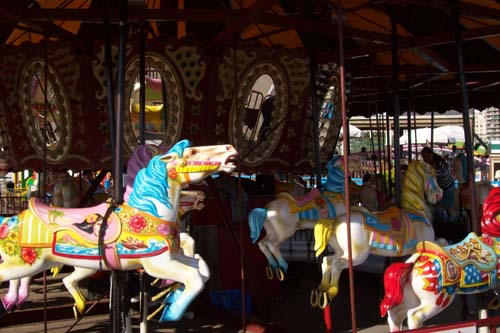
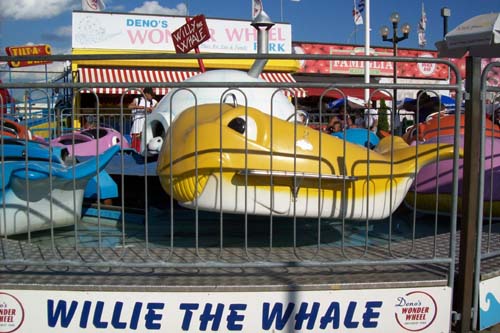
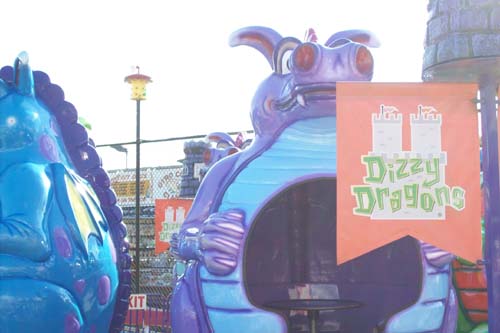
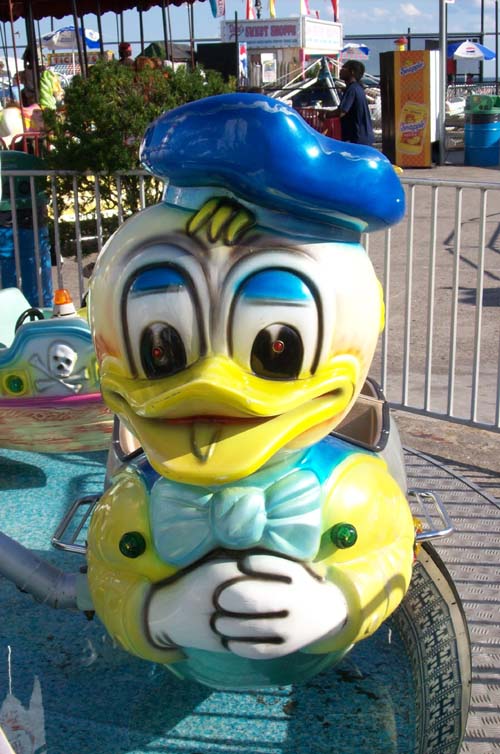
Here are some snapshots of the kiddie rides over at Deno’s Wonder Wheel:

Carousel

Carousel

Willie the Whale

Willie the Whale

Dizzy Dragons

Dizzy Dragons

Donald Duck

Donald Duck

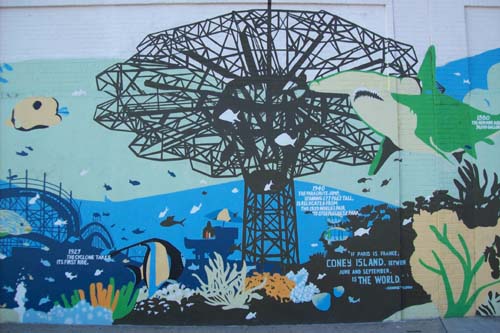
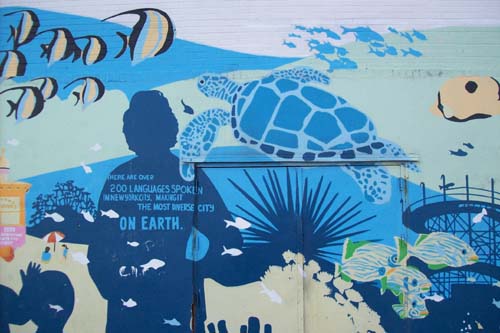
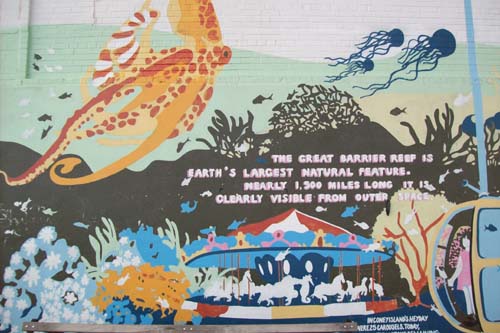
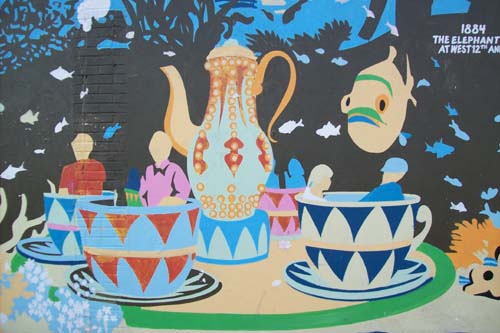
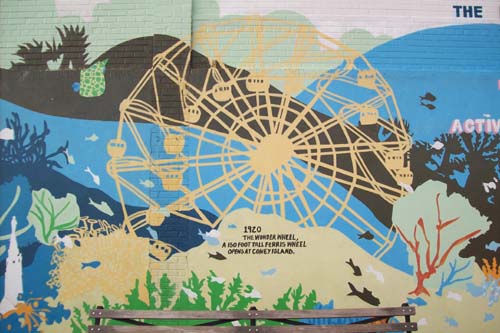
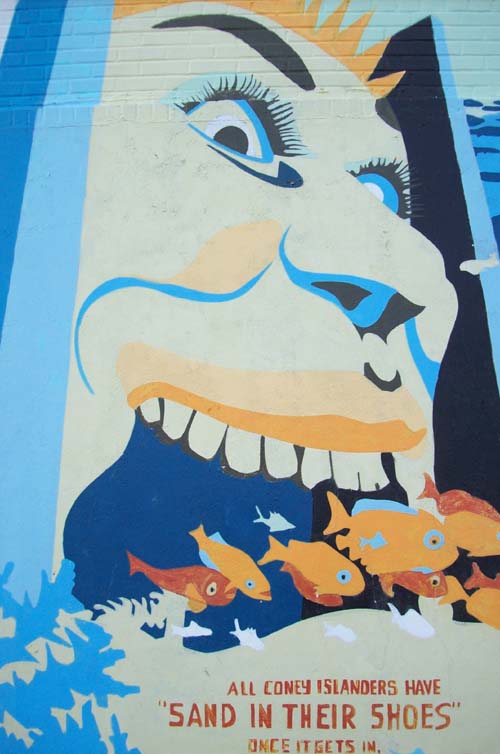
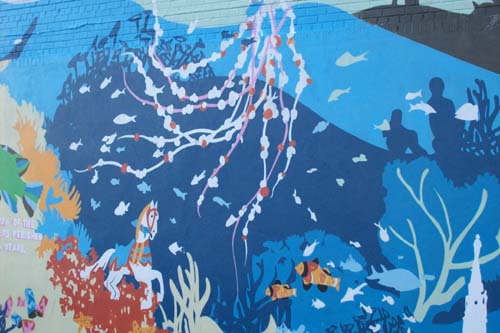
These next few sample shots below are interesting to say the least.  They’re located just before Coney Island, along the Boardwalk, but after the Brooklyn Aquarium.  The murals on the super long wall are a montage to the sights and sounds of not just the Aquarium but Coney Island’s history and culture.   It will give you a general idea as to what various portions of my article will consist of. 

History of Coney Island and Brooklyn Aquarium - mural wall

History of Coney Island and Brooklyn Aquarium - mural wall

History of Coney Island and Brooklyn Aquarium - mural wall

History of Coney Island and Brooklyn Aquarium - mural wall

History of Coney Island and Brooklyn Aquarium - mural wall

History of Coney Island and Brooklyn Aquarium - mural wall

History of Coney Island and Brooklyn Aquarium - mural wall

History of Coney Island and Brooklyn Aquarium - mural wall

History of Coney Island and Brooklyn Aquarium - mural wall

History of Coney Island and Brooklyn Aquarium - mural wall

History of Coney Island and Brooklyn Aquarium - mural wall

History of Coney Island and Brooklyn Aquarium - mural wall

History of Coney Island and Brooklyn Aquarium - mural wall

History of Coney Island and Brooklyn Aquarium - mural wall

A Flat Fee job, nevertheless, but one that I can be proud of.  I hope fellow New Yorkers will feel the same.

Most of all, I’d especially like to thank two other people for their contributions.  Fellow muse, Arlene Rose, for helping me secure photos to this past year’s Mermaid Parade (something I would never have been able to get for this freelance project), and Arturo Ramirez, for getting me better photography equipment at the last minute.

For general information about Coney Island, visit: http://www.coneyisland.com/

Coney Island Photographs © 2008 Lawrence R. Dagstine

Withersin Magazine, Coming 2009/2010… (acceptance)

Withersin Magazine picked up a piece of mine for 2009/2010.  Published thrice per year by Editor Misty L. Gersley, it’s just one of those professional horror journals that are well-put together and you can’t get enough of.   Each issue is 6×9, 100 perfect-bound pages, and only $20.00 per year for a subscription.  Fiction, non-fiction, art and MORE! Info to be released as I get it…


 http://withersin.com/withersin.htm


Other New Entries: “Magazines”