The Orange & Bee | Substack Publication – Professional Venue for Magical Stories and Fairy Tales…

I have a professional credit (8 to 10 cents per word) in the Substack publication, The Orange & Bee. It’s a flash fiction piece, and this would be my third pro credit the past three years. The Orange & Bee is a venue with thousands of subscribers. They seem to update their newsletter-like publication on a weekly basis, and their mission is to publish stories aimed at enchanting readers. They offer critiquing services, and have something called writing and reading “roundtables.” They also seek contemporary short stories inspired by a long tradition of fairy tales. But they celebrate all styles and genres, as they aim to explore, expand on, and subvert the rich traditions of international folklore. They publish poetry and non-fiction, too. According to them, they look at stories that stretch between the shadows. Which is good, because my story this time around falls into this category (along with the theme of loss and grief). Read my flash fiction story, “Shadow Play.” In the Oct. 24th 2025 edition of The Orange & Bee…

The Orange & Bee – Professional Substack Publication

Featuring Dagstine flash fiction piece: “Shadow Play”

The Orange & Bee MAIN PAGE – (click link, be redirected):

https://theorangebee.substack.com/

Lawrence Dagstine piece, Shadow Play – (click link, be redirected):

https://theorangebee.substack.com/p/shadow-play

And be sure to subscribe to them for weekly content! As in upgraded subscription!

I’ll put the banner above in magazines, since that’s where I put webzine-related stuff for close to twenty years.

Other New Entries: “Magazines”

Lawrence Dagstine: “2024 was my most productive year…but wait, there’s MORE…

2024 will arguably go down as my best year in writing and submitting; 2023 wasn’t so bad either (The Nightmare Cycle was published and I got an advance for it). I wrote a record sixty-five short stories between November 2023 and December 2024—all new. During that time, I also received the most book, anthology, and magazine acceptances (some yet to be released) for a single calendar year, surpassing my previous record year of 2008. I received acceptances from a variety of markets—mainly genre, as that is my specialty—in science fiction, fantasy, horror, and even humor. These markets ranged from pro-identifying to token, including small press and micro press. I also appeared in two anthology-magazines that went to number one on Amazon; another Kindle Anthology broke the Top 100 in World Literature, and a handful of my other offerings made it into the Top 100 or Top 500 sales rank-wise. That’s never happened to me before. Additionally, I have a couple of new books out right now (see right-hand column, scroll down).

My rejection ratio was fifteen turn-downs for every acceptance, if you’re curious about the odds. Yes, where there are acceptances, there are rejections. It comes with the territory. But I’m not here to toot my horn. This was a personal goal I wanted to achieve, and I did. I wanted to see if I still possessed that 2000s-era magic.

At fifty years old, you stop measuring press levels—Pro, Semi-Pro, Hobby, Indie—and accept whatever comes your way, especially if it’s available physically (paperback or hardback), and you know how to hustle and sell it. Believe it or not, most of my readers are not from the United States. Many Americans are too dependent on technology, staring at their smartphones all day, or engaging in activities that don’t involve literature. If they do read, it’s usually the “obligatory” twelve books per year—one per month. I’m guilty of this myself. I used to read a hundred books per year, but as you get older, there are only so many hours in a day. Most of my readers hail from places like India, Japan, and, oddly enough, Belgium. Earlier this year, readers from India wrote to tell me how much they liked my horror stories. I appreciate that; I’ve never received such feedback from US readers. Obviously, I was flattered. I joined two writing groups in Manhattan, got the necessary certifications, and became a writing teacher, which is relatively easy in New York State compared to other places.

As we get older, we often become adjunct professors, tutors, instructors, substitute or assistant teachers. We take up residencies, shepherd online MFA programs, hold online and in-person workshops, and add experience to our curriculum vitae. The revenue from these workshops helps fill our fridges. We may teach English as a second language if we move overseas or teach the short story form, novel writing, story analysis, and linguistics. We show younger writers our techniques and formulas, paving the way for them and enlightening them on how we did it. We pass our knowledge to the next generation of aspiring writers. We take on protégés. Other jobs we take on include writing advertising copy, technical writing/business writing, expository essay writing, things like that.

I can’t believe I’ve been doing this for thirty years. Sometimes I wonder if I wasted my life. Should I have pursued another field? Should I have become a full-time artist and taken up comic illustration, which was my passion in the early ‘90s? Despite my love for science fiction, I would have preferred seeing the art through. I lost my love for drawing in late 1994 and turned to writing instead. Applying for art jobs thirty years ago, where prospective employers said comic art and graffiti art weren’t “real art” didn’t help. So I ended up in writing. I appeared in a couple of magazines, made some cash, and bought nice things. Picking up every genre magazine I could get a hold of in Borders and meeting Kurt Vonnegut regularly while working as a delivery boy for a pharmacy further fueled my enthusiasm.

Author Mercedes Lackey once noted that 90% of the writers in the SFWA (Science Fiction Writers Association) have had or currently hold full-time jobs. The rest have spouses who work full-time, serving as the breadwinners, covering the overhead, and providing health insurance for the family. Alternatively, the full-time writer might be retired and living on a pension or 401K. I could join the SFWA tomorrow. But at my age? For what? Bragging rights? I’m ready for the grave. This isn’t to say I won’t produce an anthology in the future. I’m full of ideas, and I won’t accept anything less than outstanding. But hey, I’m old. Many of the books with my stories are published by presses that might not exist in five or ten years. Presses come and go; the same can be said about good books. Publications go on lengthy hiatuses. Economies rise and fall. Inflation affects spending habits. People’s reading preferences change. Advertising techniques and technology evolve. Not only that, over 10,000 books are self-published per day, so there’s no such thing as professional competition anymore. It’s a too-open field. Also, generational shifts happen, and what was popular with one generation might not be with the next. How many people do you know in 2025 who have a profound love for Philip K. Dick, Isaac Asimov, and John Brunner like I do?

I’m very much a socialite. I often go into the city, visit upscale places, penthouses, private parties, and get the VIP treatment. I network and get my books into these places. You have to network in this day and age. Word of mouth is still a very powerful tool, and you want to get non-genre readers interested in reading genre. When I sit down with a glass of wine and talk to affluent or corporate types about horror, they say, “Oh, Stephen King!” And that’s it. They don’t know anybody else. They think Stephen King is the only author there is when it comes to horror. I say, “You haven’t read the work of Paul Tremblay, Stephen Graham Jones, or Josh Malerman?” They give me a daft look. Who? What? They don’t even know that Stephen King has two sons who also write (Owen and Joe). They think Stephen King never had children. But we know. Because writers read each other. We are aware of each other. And it’s kind of depressing in a way. It’s like we’re trapped inside this shrinking genre bubble, and you’re not sure if it’s going to burst or when it’s going to burst. It’s disintegrating, for sure, it’s just a matter of when. You hope it pays your utilities for as long as it can, at least until you take up a teaching position or land an agent. Only 15% of writers ever land an agent and break into the Big Five. And that number shrinks with age. Some are luckier than others; your mileage may vary. What happens for most, whether traditionally published or indie-published, is we end up at genre conventions, gaming cons, comic cons, indie bookstores, or local fairs and fests, and our literature is available at vendor tables.

Nowadays, many people publish each other in a quid pro quo fashion (tit-for-tat), which is fine, but simply reading each other’s work isn’t sustainable in the long term. It seems we’re just passing time until we reach the end. If we’ve chosen writing as our forte, we must have a lot of time to spare. Some of the biggest names, award-nominated genre writers, are suddenly submitting to semi-pro and token markets. This used to be a no-no. Yesterday’s professional paying magazines now depend on Patreons or annual crowdfunding just to survive. And then there’s Artificial Intelligence, which will inevitably replace us in the next 20 years. I’ve seen some of these young tech kids at conferences, and what they can do with Python and Stable Diffusion; they’re smart.

Publishing was a very different animal in the first ten years of the Internet. You could actually make an income from freelancing regularly, and web content was big! Webzines were especially big. They were new, they paid fair money, and there wasn’t much of an editorial filter, but you got your byline and content out to the world. A handful of these sites were built with Dreamweaver, Frontpage (Microsoft), or typical HTML coding. Some were even hosted by GeoCities. Plus, the cost of living was cheaper back then (my rent was only $650 to $750 per month during this era, utilities included). You could stay home, take care of the kids, and have paper checks coming to your mailbox. This was still before the age of PayPal, Venmo, Zelle, and other electronic payment methods. So it was paper checks. If you were a freelancer of genre fiction and creative non-fiction, and you were a quick writer and productive, you got paid $20 to $50 per piece consistently! Sometimes more, sometimes less. One on top of the other. Some of the webzines that appeared in the first ten years of the Internet were Atomjack Magazine, Whispering Spirits, Midnight Times, Dawnsky, The Random Eye, Gotta Write Network Litmag, and hundreds of others! I appeared in many of these places, scouring market sites like Ralan and Spicy Green Iguana on a daily basis. The Boomers never went near these little zines, but I did. And I got my name out there. And I was paid. And I bought clothes. And I bought food. And I paid bills. At one point, I even had a $6000 bank account put aside for my infant son—from writing. There was a time when I had 200 different stories in a folder on a Windows XP laptop, and I would submit to any paying market, even those offering $5.00 compensation. Acceptance here, acceptance there. You do the math. You might find these webzines on the Wayback Machine, but if you’ve heard of the ones I just mentioned, you’re old and gray now, just like me.

To this day, I think the periodical I was paid the most for a single story or article was in either 1999 or 2000, and this was in a queer publication called GENRE Magazine. Or just Genre. And it had nothing to do with genre. They didn’t even publish science fiction. That was just the name. It was primarily a New York-based gay lifestyle magazine with a modest circulation for its time period. It was distributed to LGBTQ-identifying establishments before LGBTQ was even a term. Before ebooks, before Amazon, when physical publications still had modest circulations. When people still relied on the Writer’s Market. I was paid $750 for two, maybe three hours worth of work. The editor said he would take care of the grammatical errors. I kept my mouth shut, let him handle it. Nowadays, twenty-five years later, that same $750 is your paycheck for a horror novel to a rising indie press.

Still, I’m thankful I didn’t become a full-timer in this day and age. I own nice things. Call me materialistic, but I enjoy my little luxuries: designer clothes, nice electronics, video games. I can buy my family birthday and Christmas presents. I can wine and dine on occasion. Some writers who went all-in don’t have that luxury. Imagine not having health insurance, unable to run to an emergency room or urgent care. A vast majority of writers don’t have insurance. Sure, some scored two or three-book deals with the big houses, only to not sell to expectations and never be heard from again. So when people ask me what advice I would give an aspiring writer in 2025, I say, “Don’t quit your day job. Do this strictly for passive income. Do this because you love it. For the sake of art. Do this because you like to tell stories. And read!”

Listen, H.P. Lovecraft died extremely poor. He couldn’t afford treatment for his small intestine cancer, compounded by his fear of doctors. So, he wrote and lived in daily pain—not a pot to piss in. Some of his finest works weren’t noticed until decades later. John Wyndham, a prominent British science fiction writer, was often overlooked in his lifetime. He didn’t receive the recognition he deserved, even as the author of “The Day of the Triffids.” It’s only now, in the 21st century, that his shorter works are being sought out and reprinted. John Brunner, author of mega-hits like “Stand on Zanzibar” and “The Crucible of Time,” feared failure. He wrote under a pen name in his later years and worked as an underpaid proofreader. But regardless of success, they were storytellers. And there’s nothing wrong with being a storyteller. If you get paid for it, that’s like the cherry on top of a hot fudge sundae.

Looking back, I’d say I’m privileged. I’m not a New York Times or USA Today Bestseller by any means. I see myself as a semi-pro of the short form, one of those one-to-three cent jobbers. Apparently, I’m a jobber who makes it into the TOP 100 often; I probably would’ve really crushed it during John W. Campbell’s era. Many writers don’t get to do this for three decades, non-stop. Today, many people self-publish books that are mediocre at best, invest in Amazon Ads, and suddenly they call themselves bestselling authors. They don’t know what it’s like to have spent time in the trenches. Otherwise, a handful of the younger kids coming up don’t know how to read, write, spell their names, or pick up a book after high school. I definitely didn’t think I’d become a teacher. Like I said, I feel privileged. I came to this earth and got to do it. And I’ll try to continue doing it for as long as I have the desire.

This is Lawrence Dagstine, prolific writer for the past thirty years.

Storyteller. Jobber. Future anthologist? I could live with that.

Edited to Add: This essay, which I write from firsthand experience, will be reprinted in a newsletter, currently under development. Stay tuned for news of that.

Wicked Shadow Press: “Masks of Sanity – The Monster Within” – ANTHOLOGIES!

Let it be said Wicked Shadow Press is slowly dominating the horror anthology market! Their anthologies focus on a particular theme, keep to that theme, they make their books beautiful both inside and outside, some times with art, give each title collectible value (I saw one book fetching $95.00 on Ebay few months back), and they have heavy exposure in India. The next title is no exception, and I have a story within its pages which I first wrote in early 2004. Twenty years ago, and it’s nice to see my tale within this next book. Wicked Shadow Press presents: “Masks of Sanity The Monster Within: Stories of Secret Psychopaths”

This is the perfect year for psychopath stories too, with Joker 2 due out in the Fall with Joaquin Phoenix and Lady Gaga. My tale is called, “The Scourge of Nine-Rah.” It’s about an investigative writer who gets mixed up in an whole underground cult of psychopaths who do the most horrific things. Think Charles Manson mentality. Heavy on the horror, just as uneasy on the suspense, be sure to check out Masks of Sanity: The Monster Within. Pictures and links below or off to the side (scroll down).

MASKS OF SANITY – THE MONSTER WITHIN

STORIES OF SECRET PSYCHOPATHS

Featuring Dagstine Cult-Psychopath story: “The Scourge of Nine-Rah”


Paperback: https://www.lulu.com/shop/parth-sarathi-chakraborty/masks-of-sanity-the-monster-within/paperback/product-kv98726.html

Epub/Ereader: https://www.lulu.com/shop/parth-sarathi-chakraborty/masks-of-sanity-the-monster-within/ebook/product-yvnzr4n.html

All India Free Delivery! Whatsapp 9830652666 to order your copies now!

Like Wicked Shadow Press on Facebook: https://www.facebook.com/wickedshadowpress

Follow Wicked Shadow Press on Instagram: https://instagram.com/wickedshadowpress

Follow Wicked Shadow Press on X: https://twitter.com/wickedshadowpub

Be part of Wicked Shadow Press’s Facebook group to get regular author-related info: https://www.facebook.com/groups/7867933553277077/

Other New Entries: “Books & Anthos”

Lawrence Dagstine: “How to Make Money at Signings…”

“HOW TO MAKE MONEY AT BOOK SIGNINGS”
dagstine-merch-1

AT OUTDOOR EVENTS & FOR THE INDEPENDENT/NEWBIE AUTHOR

by Lawrence R. Dagstine

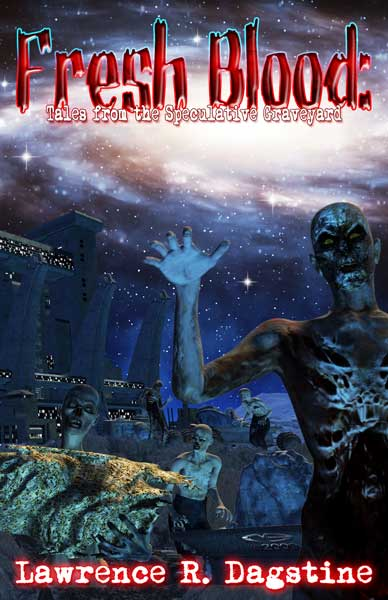
A lot of people have been “hinting” recently on places such as Facebook and via email looking for advice.  They want to know how I did it.  They want to know how to make money selling books and magazines at functions and signings, especially if you’re an independent/newbie author.  As many people already know, I came out of a series of signings at Coney Island, New York this past summer with a decent intake on such titles as FRESH BLOOD (see Books & Anthos), and more.  Writing is pretty much an extra income field for a majority of us.  Once you learn to accept that, and not depend on fiction or look forward to fancy six-figure careers, you find your comfort zone.  The checks that come in repetitively or non-repetitively may pay for such things as utility bills, groceries, little odds and ends in places like Rite-Aid, CVS, or Walmart, co-pays on prescriptions, dinner and a movie, or something as simple as a gallon of milk or filling up your gas tank.  Of course, all of this might not come from fiction, but that’s okay.  After all, it’s a starving profession to begin with.  In this recession, every dime that comes out of the written word counts, because you never know how much your next electric bill or gas bill will be.  For example, right now I’m doing people’s resumes.  If you’re already an established, professional author with a couple of novels out, this information probably won’t help you, as you already make a nice income from being an upper midlist author or being able to relax on what royalties and advances you make from mass market paperbacks.  That, and some of your publishers may already foot the bill for some of your traveling expenses from signings.  But nowadays it’s very rare unless you’re a lead-lister.

However, if you’re an independent/micro-press author who lives in a big city or a pretty happening little town, whose been published in lots of print magazines, maybe a few anthologies, has a new book or collection available through a POD press, has access to a small newspaper (bonus points here), this information might help you better understand the kind of buyers that you want to attract, the places you want to sell, the performance you want to give when selling, how much to pay for dealers’ tables, number-crunching, and, what seems to work and not work “perception-wise” when selling to an audience outside of genre, because let’s be honest—that’s the consumer you’re gunning for, and they’re hard to reach.  At the end of the day they’re still a reader of Charlaine Harris, Dan Brown, or James Patterson.  You want to sell to both genre readers and non-genre readers alike.  Most likely, you work a day job, or maybe you’re on a fixed income.  You need to rely on a budget throughout, cut corners when necessary, because this article is recession-friendly.  People may perceive you as a hack, an amateur, people you know for years may perceive you as a pro, a super-pro, or even Superman! But no matter what kind of author you are, the moment you sat down at that table and sold a variety of stuff with your name on it, you were no longer just an author.  You also became a merchant and a bookseller, and you need to keep that mindset.

If you do live in a big city or a small town and haven’t been able to get signings in places such as Borders, Waldenbooks, or Barnes & Nobles, that’s okay.  In this economy, if you don’t expect family or friends to show up (or friends of those friends), chances are you’ll only sell less than twenty copies anyway and look like a schmuck at a table in the corner with a bowl of lollipops or cookies.  Somewhere away from the door if you’re not cozy with the store manager.  I chose Coney Island because it was a seasonal attraction—over five million visitors per summer—rather than a one-day gig, and I’d known about it almost a year in advance because I did some writing and research for one of their papers.  I knew people, and I made connections.  And if you can make connections, and you know the turnout is going to be big and profitable in advance, and it’s inexpensive to show up and conduct your little set-up, then what are you waiting for?

Fact: five-million people do not visit a Borders bookstore over the course of a summer — matter of fact, they’re closing stores, and I would be surprised at how many more survive — neither does that amount visit an independent bookstore, which I find to be a good way to do nothing, sell nothing, and just kill the day in a chair.  A world famous amusement park and tourist attraction is a whole other story.  Even little carnivals passing through town may attract more visitors.

Of course, there are always exceptions.

If you’re not selling in places like the chains, then you still want to add some diversity to your table, make it look pretty: business cards, flyers, postcards, magnets, or buttons made up cheap.  I recommend Vistaprint (www.vistaprint.com).  You can get stuff made up by them quite often for free.  All you have to do is pay the shipping & handling.  Some of the greatest places to sell books, and which attract crowds are book fairs, street fairs, flea markets (outdoor, indoor, churches and synagogues), carnivals, community centers, town halls, schools, festivals, bars… But mostly outdoor events in spring and summer.  Warm weather.

One writer asked me how much should he pay for tables (or, in some cases, booths).  I would say if you’re an independent author DO NOT pay more than a hundred bucks for a table (but that’s just me).  If you don’t come out of your signings making a minimum of 70 to 80% profit, don’t even bother reserving a spot.  Why? Because you need to first make the cost of the table back.  Then there’s the cost of gasoline, food and beverages (maybe even hotel and airfare).  Trust me, it adds up.  Make your signings LOCAL, and, if possible, try to split the table costs with fellow authors, too.  Oh yeah, you also want to hit up the smaller cons rather than the big cons.  Not that you shouldn’t attend the bigger cons, only that some of the smaller conventions are much easier on your pocket when it comes to the dealer’s area.  Sam’s Dot Publishing, one of my publishers, always seems to make a killing at these events.  They often sell out! Flea markets, churches, and festivals can go as low as $25 to $50.  I know this one church which holds a pretty popular flea market on Tuesdays and Fridays for twenty bucks, but you have to bring your own table.  Always packed.  Just sell a few used books, sports cards and comics on the side, you’ll make that back in no time flat.  Other genre wares should be meant to cover the cost of your table and traveling expenses.  This is a must!

When you go into a signing as an independent/newbie author, you need to go into it with the mind of a businessman or businesswoman.  You need to ask yourself: where do I expect to pick up the most sales and the best exposure.  The ice cream parlor, the town library, or the state fair (obviously the state fair).  If you need a license, get one.  They’re really not that expensive.  If you’re a newbie on a fixed income, you need to calculate all this in advance.  Don’t just sit at a table with your hands clasped, smiling and nodding at passersby.  Get up and be a regular PT Barnum.  Be jovial.  Prepare what’s called a pitch. For example: “Hello, Ma’am, you’re looking lovely today.  You must love to read.  Oh, don’t be shy.  I bet you have a soft spot for books reminiscent of Stephen King and JK Rowling!”—you get the gist (woman sees table filled to the rim with merch; friendly conversation is under way).  You need to stand up and introduce yourself.  You need to have confidence, charisma, personality, and a little humor doesn’t hurt either.  Books don’t sell themselves.  Hence why you need to be business-minded when you approach this, especially in these hard economic times, where the independent writer gets the short end of the stick.
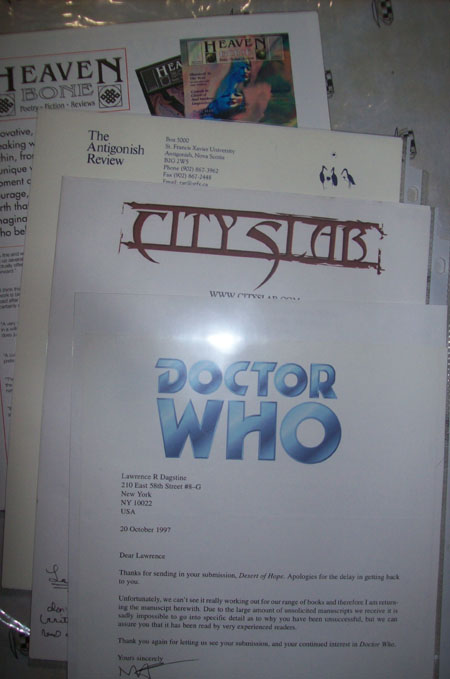
Snail Mail

Let’s talk about Coney Island now.  My very first signing on that very first day in June was a disaster.  Why? Because I had only brought Fresh Blood with me and a few used books by pulp authors.  Luckily, that first day I covered the cost of the booth (it was only $30 at the time), but I’ll never forget this one guy who came up to me and said, “Wow, so you like write stuff.  Man, I remember books.” I was astonished! Let’s just say the guy was a caveman who’d taken one too many bong hits.  How does someone forget about reading and books? Another girl just wanted her photograph taken with me because she never met an author before, yet she didn’t buy anything.  Not to mention I looked like a big tool just sitting there with one Dagstine-related item to my name when, back home, I had hundreds of print periodicals I could have toted with me.  Duplicate copies, too.  Yes, variety, along with ‘public perception’ makes for a very nice recipe, which I’ll explain in more detail in a moment.

After that first day I learned my lesson.  Between June and August there were supposed to be seven signings, but there ended up to be six due to a one-day rainout.  There would have been a few more had it not rained constantly between June and July.  And Flea by the Sea (the name of Coney Island’s summer marketplace), though covered by tents, was an outdoor event.  It was on top of the beach.  At times, the winds were horrible.  The circus was there, too, and one day there was a big hoopla going on because Ringling Brothers were abusing the elephants, but believe it or not a few of the animal rights activists picked up some of my goods.  So I can’t complain there.  But what I’m trying to say here is that, make sure it’s not going to rain on your parade on the day that you sell.  Mother Nature has a funny way of defying writers when it comes to selling outdoors.  By July and early August I was paying $40.00 for the booth and then $10.00 to rent the table, which came out to $50.00 for an entire weekend.  How could you beat that price? This is the price area you should be looking into.  Once again, a hundred bucks should always be your cap, and hopefully, you have more than one book to offer.  Speaking of which…

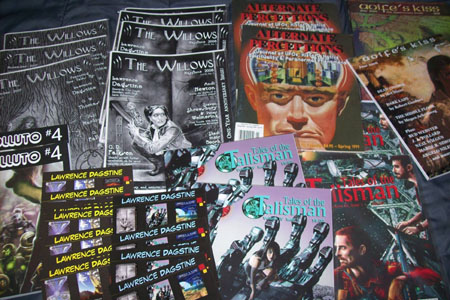
They say never judge a book by its cover.  Bullshit. When you’re selling in quantity to a non-genre and genre crowd, cover art I noticed makes all the difference.  In most cases it comes down to perception and appearances, or just the way people interpret merchandise.  I don’t care what anybody says.  They do judge a book by its cover.  And what people saw were stacks of magazines with extra copies, six different hardcovers and anthologies, and of course, a stack of Fresh Blood.  It was set up professionally and it looked pretty, like my own compact comic book shop.  All featuring something by ‘Dagstine.’

People were complimenting me because of the covers of the magazines.  Short lines and interested eyes gathered.  One person said, “So you must be Brooklyn’s SF Writer.”—I said, “Okay.” I just totally went with it.  Everything acted sort of like a cash cow.  One Dagstine publication led to the purchase or attraction of another.  Not only did one person spend $50.00 in one shot on me, but over the course of those signings I pushed $250.00 worth of old self-published hardcovers from The Year of the Flood, back when I didn’t know what the words ‘Vanity Press’ meant.  The point I’m trying to make here: I had a lot to choose from, my buyers had a lot to choose from, and so should you.  The cover art, the variety, the set-up, and “come one, come all” pitch made all the difference.  Even the shirt I wore! I got to autograph and sell my writing where, with only Fresh Blood, I probably wouldn’t have made what I did over the course of the summer: around $1200.00 – NET. And hey, I got my work and business cards out there.  Not bad for a hack, and my table investments had already been covered. 

If you’re a writer whose works have appeared in quite a few magazines, talk to the editor about getting extra issues at an author discount.  Always use media mail.  You might pay $4.00, $5.00, even $6.00 for those extra copies featuring your work in it.  You’re going to autograph them and sell them for $8.00 to $10.00… And don’t forget what I said, once you’ve included the cost of the table, food and beverages, gas or transportation to get to your selling destination, you need to make a minimum of 70 to 80% profit, otherwise it’s pointless.  Remember to invest in your work, invest in yourself, and before you attend that signing with more than one book or periodical, sit down with a calculator and crunch those numbers.  Make sure the location is going to be worth the time and effort.

In closing…

Whether you’re selling indoors in some chain, an artsy-fartsy independent that has velvet couches and serves Lattes and marble loaf in the back, or you’re giving the outdoor thing a whirl like I did, there is also another reason why you need to impress that passerby.  Besides cover art and quantity, nine out of ten times the general reading public will throw down cash on used books, non-fiction, children’s books, fast-paced thrillers, or romances before they will genres or subgenres known for killer slugs, planets with giant lizards, what the future would be like if everybody were pink, zombie stories, and heroic fantasy yarns.  If you’re a writer of genre fiction, you’re automatically at a disadvantage, so you need to think of ways to catch up.  That’s why the business model/bookseller mentality is so important.

Still, if I could do it with twelve hundred smackers, with a little initiative, so can you.

Until Next Time,

Lawrence R. Dagstine

Lawrence Dagstine: “FRESH BLOOD Signings…”

Come join prolific short story writer, Lawrence R. Dagstine — scifi, fantasy, horror and more! — at Coney Island’s “Summer of Signings”.  Twice a week, every other week this summer at Thor Equities’ new DREAMLAND! — Festival by the Sea

Flea by the Sea
Flea by the Sea

 VENDOR DETAILS:

http://www.fleabythesea.com/about.php

Brooklyn Author, Lawrence R.  Dagstine will be signing copies of his new short story collection FRESH BLOOD, rare hardcovers, anthologies, and obscure pulp magazines and more at FLEA BY THE SEA! Stay tuned for booth locations and exact dates.

WHY COME HERE? 

http://www.fleabythesea.com/why-come-here.php

FIVE MILLION PEOPLE — THAT’S WHY!

And the amusement park, and other sellers, and the beach! Loads of fun!

http://www.fleabythesea.com/rent-a-tent.php

Stay tuned for times and dates.   Transportation by subway and other details can be found on the site.  Times are usually weekends, 12pm to sundown (or 9pm)! Off-peak dates will be updated here depending on booth availability.

Sam's Dot Publishing, ISBN: 978-0-9819696-2-6

 Also available from THE GENRE MALL:

http://www.genremall.com/anthologiesr.htm#freshblood

 Other New Entries: “Public Events”

Sam’s Dot Publishing: “Convention Calendar Early 2009…”

This comes a little bit late, but Sam’s Dot Publishing books and magazines will be available at the conventions just below.  Aoife’s Kiss, Beyond Centauri, Sounds of the Night, Champagne Shivers, and more! I would say once the April conventions hit, you can ask for FRESH BLOOD (my latest collection).  It should be available then.  They publish a whole array of wonderful periodicals, novellas, and other genre fare. 

samsdot1

www.samsdotpublishing.com

EVENT DATES AND LOCATIONS:

20-22 March: MidSouthCon, Olive Branch, Mississippi
27-29 March: ImagiCon, Birmingham, Alabama

10-12 April: MiniCon44, Minneapolis, Minnesota

24-26 April: Conestoga, Tulsa, Oklahoma

1-3 May: DemiCon, Des Moines, Iowa

22-24 May: ConQuest, Kansas City, Missouri

As for myself, due to the recent woes of the U.S. economy, I probably won’t be leaving the Northeast anytime soon.  But I will be walking the floor of this year’s FANGORIA Weekend of Horrors.  If you see me, stop me.  Say hi.  I’ll be representing a bunch of publishers and handing out free merch! Also, now that the weather is getting nicer, I’ll be attending book fairs and book festivals, and hopefully the odd reading or two. 

More to come.

KGB BAR: Jack Ketchum/P.D. Cacek Reading…

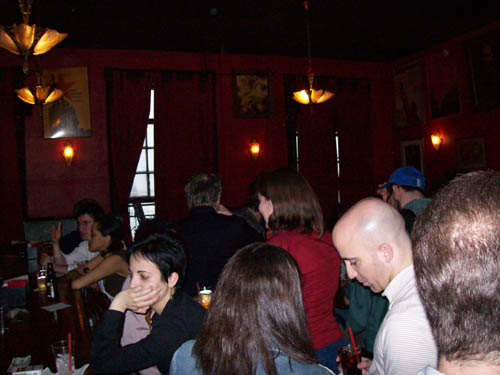
On April 16th 2008, I took the day off and headed into the city — the Village, to be exact — to see horror masters Jack Ketchum and P.D. Cacek perform live readings of their works.  KGB Bar is a pretty renowned institution when it comes to live performances by writers and poets.  It has that dimlighted, hip, semi-beatnik kind of style, crossed with the feel of an old man’s bar.  It’s small but stylish, too, reminiscent of socialist artist hangouts.   It’s located at 85 East 4th Street, just off of 2nd Avenue, second floor.


*KGB Bar Logo*

*KGB Bar Interior; Second Floor*

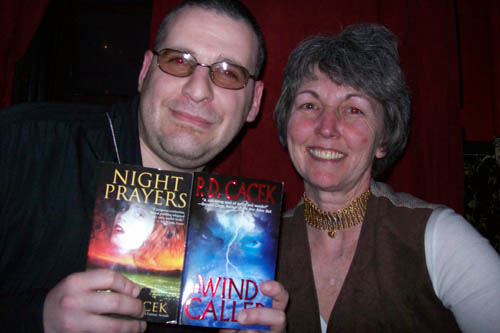
It wasn’t overcrowded or anything like that.  I got there around six, left at nine.  Some of the pictures were taken by me, and others such as Gordon Linzner and Linda Addison, (Bram Stoker winner of: ‘Being Full Of Light, Insubstantial’).  I congratulated Linda on winning the 2007 Bram Stoker Award.  Also up in the mix was Gerard Houarner, a prolific author in his own right; he edits Space & Time Magazine and writes a monthly blog column for Storyteller’s Unplugged.  Matthew Kressel, of Sybil’s Garage, co-hosted the event with Ellen Datlow.  And just by chance, I happened to be seated at the end of the bar with science fiction author, Mercurio Rivera, who has a story in Interzone #214.

*Lawrence Dagstine with Bram Stoker Winner P.D. Cacek*

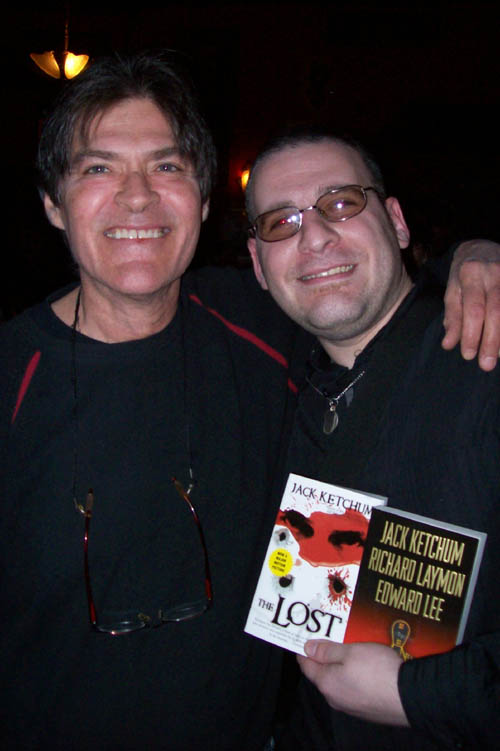
*Lawrence Dagstine with Four-Time

Bram Stoker Winner Jack Ketchum*

P.D. Cacek read from a short story with a young person’s narrative.  She went on first at seven o’ clock.  After that, there was a short intermission where authors and editors could mingle a bit, while Jack Ketchum made his way to the small podium in back.  Jack read from three pieces, one of which was a monologue in a female narrative, and this was supposedly originally written for his novel, THE LOST (now a motion picture).  The third piece he read was a story from what he called his “VHS Days”.  He has a great voice, knows how to entertain the reader and his listeners, while mixing humor in all at the same time.  I’m telling you, the man is pure genius…


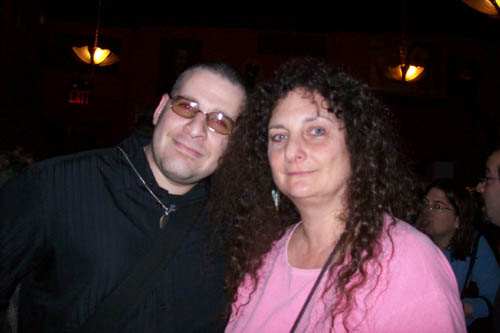
*Lawrence Dagstine with Editor Ellen Datlow*

I also got to take pictures and talk with the Industry’s finest editor; and probably one of the best in the world.  Ellen Datlow.  At first, when I approached her, I was a little shy, because it had always been a dream of mine to talk to Ellen.  I’ve been a fan of hers since she was fiction editor for OMNI Magazine.  And back in the 1980’s, thanks to influential people like her, I don’t think I would have chosen writing as my career path.  At first, I addressed her, “Ms. Datlow…” – but she quickly said, “Please, call me Ellen.”

A wonderful and memorable night indeed.  I got to meet three icons.  I stocked up on reading material for me and my son; Jack Ketchum and P.D. Cacek were nice enough to autograph it to him for when he’s old enough to read horror.  I also noticed something else.  These people were not only pleasant, but they were down-to-earth.  And I realize now that’s what writing is about.  It’s not always about how much money you make, who is better than this one, I’m going to be famous overnight.  It’s about being nice and appreciating the artform. 

Being a writer is about being down to earth.  It’s about being human.  It’s about being yourself.

Until my next entry,

Lawrence R. Dagstine

Other New Entries: “Readings & Reviews” (photographs archived)